Guild Driven Development: The Review Guild Model for AI enabled development

The pace of change across the AI industry is blowing my mind.
It is not just that code gets written quicker. It is that code stops being scarce. A small number of people with technical clarity can now use AI to produce a volume of implementation that would previously have required a much larger team.
That changes the structure of the work. The constraint is no longer only "who can write the code?" It becomes "who can absorb, evaluate, and safely merge all of this output?"
If output becomes cheap at an acceptably low risk (and it is heading that way), the constraints move to:
- deciding what should exist
- keeping the system coherent while it changes rapidly
- catching subtle breakage before it hits production
- maintaining an honest map of what the system even is anymore
In other words, the main constraints become direction, meaning where the codebase should evolve, and trust, meaning whether the stream of changes is correct enough to merge.
That is where Guild Driven Development (GDD) comes in.
The Core Idea
Guild Driven Development is an operating model for the moment when a small directing group can generate more implementation than a normal team can review informally.
It has three parts:
- an Architect Commander owns direction (technical and product constraints)
- an Agent Swarm produces implementation as tiny, reviewable diffs
- a Review Guild absorbs that output and decides what becomes real
This is a practical response to a world where PRs can be generated continuously. The bottleneck is no longer writing code. It is deciding what deserves to enter the system.
Thought Experiment: Unlimited Output, Limited Trust
Imagine a normal company codebase. Not a greenfield demo. A real system with sharp edges, "do not touch that" zones, and ten different ways to accomplish the same thing.
Moving through this kind of code base is slow. It is cognitively expensive, emotionally fraught, and socially exhausting.
Now add a swarm of agents that can:
- read the repository
- implement tasks
- write tests
- open PRs
- respond to feedback
At first it feels like velocity. A few strong engineers can define slices, aim the agents, and produce a flood of reasonable-looking PRs. Then the code reaches review.
The question is no longer "how do we build?" It is "how do we decide what is safe and coherent to ship?"
That is what the Review Guild is for. It is the structure that lets the organization absorb AI-amplified output without pretending that all output is equally trustworthy.
What the Review Guild Actually Is
I am using the name "Review Guild" because it describes the role better than "reviewers" does.
The Review Guild is:
- the group with merge authority
- the keepers of standards
- the maintainers of coherence
- the people who treat review as an active discipline, not a background chore
It is the system's immune response. It is the human-in-the-loop component of an AI-driven development system.
Here is my word of warning:
In AI-assisted development, it does not matter if you refuse to formalize a way of dealing with this influx of change. Your teams will silently invent one through pain. PR load will rise. Review pressure will rise. Developers will assume they are supposed to write more code and review more code at the same time.
Even if you do not formalize it, the role will still exist. It will just exist as an invisible hierarchy with unclear rules. GDD makes it explicit, measurable, and improvable.
Review is not a speed bump. It is the control surface.
The guild's primary job is review, but it can also be responsible for:
- defining what "done" means for a given change
- owning the release process
- being the final arbiter of what is in the codebase
The uncomfortable implication is that you may need more review capacity than coding capacity. Before AI, those numbers often looked equal because the same people wrote and reviewed at roughly human speed. Once a few people can create a much larger stream of AI-assisted change, the review side has to grow.
The One Rule That Makes This Work: Evolutionary Change
Big PRs are where shipping confidence goes to die.
Intent gets blurry. Reviewers miss things. Everyone approves because they are tired.
Guild Driven Development only works if the Swarm outputs evolutionary slices:
- each change is small
- each change is locally testable
- each change is reversible
- each change has one reason to exist
- each PR is reviewable in minutes, not hours
This is not style. This is how you make a high-throughput system stable. It is how you prevent an agent swarm from becoming a chaos generator.
Of course - sometimes you must ship a larger change. That is fine. The key is that the system defaults to small changes, and large changes are the exception, not the rule.
The GDD Loop
This is the loop you are building:
- Architect Commander defines direction and constraints
- Commander produces a task stream of micro-slices
- Agent Swarm converts slices into micro-PRs
- the Review Guild reviews, corrects, and merges
- mainline stays deployable
- production signals and review feedback flow back into the Commander's model (which can include agent memories)
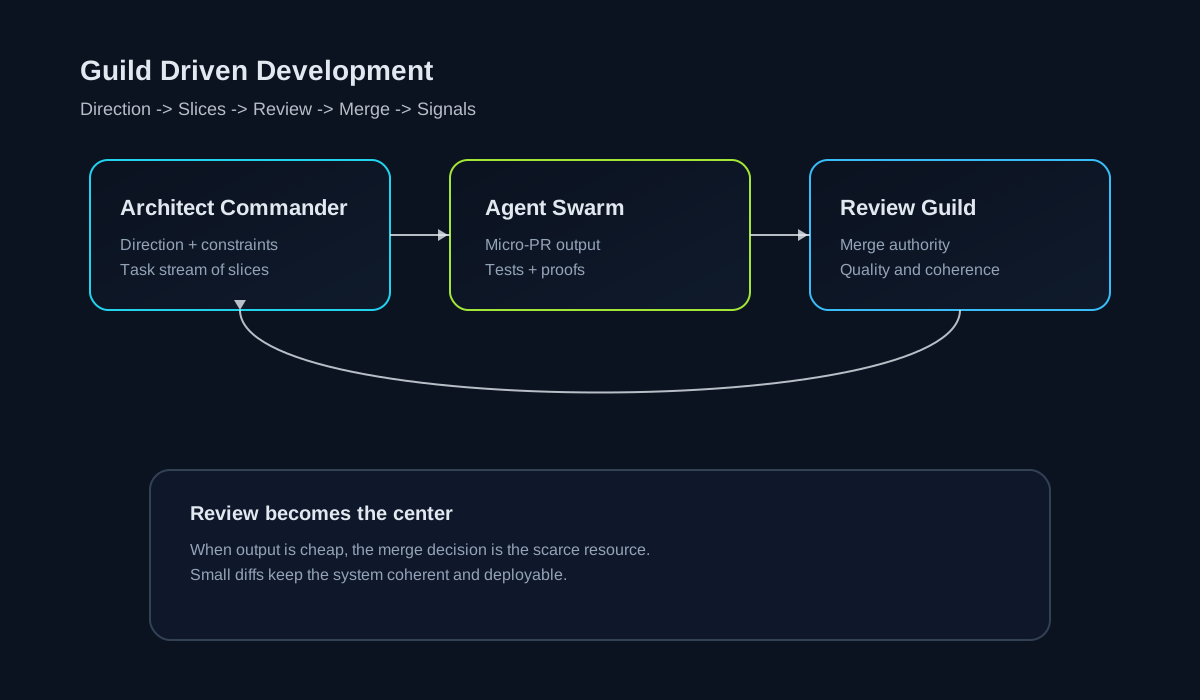
That is the engine. The Review Guild is the part that absorbs the output and prevents incoherent change from becoming reality.
Why GDD Scales Inside Existing Companies
Existing systems are hard to work with, but not because the code is hard. They are hard because they are socially hard:
- too much context is tribal
- boundaries are muddy
- refactors get scary
- migrations are "big bang" events
- correctness is difficult to prove
GDD attacks that by reducing how much of the system any one change needs to understand. It leans into the unavoidable fact that we need humans setting high-level direction, AI executing details, and humans again confirming that the work is good.
If the Swarm is working in one bounded area, they do not need global understanding. They need:
- local rules
- clear seams
- the ability to ship safe increments
A critical aspect of this is that the Review Guild does not spend its main cognitive capacity producing code. It spends that capacity understanding the change and its impact, with the help of AI.
How You Actually Roll This Out
Start with one team.
Step 1: Pick a Subsystem with Leverage
Choose something that:
- has visible pain
- can be measured (incidents, lead time, deploy risk)
- has semi-clear boundaries
Step 2: Write the Guild Rules
The Review Guild needs practical rules:
- maximum scope per PR
- what "behavior change" means
- what needs tests
- what needs a rollout flag
- what requires a design note
- what gets rejected on sight (risk patterns you know you hate)
Teams stumble here because they do not like being explicit.
Step 3: Commander Builds the Slice Stream
Not "implement feature X." More like:
- create seam
- characterize behavior
- move one call site
- move the next
- introduce the new path behind a flag
- measure
- delete the old path
Step 4: Swarm Produces PRs Continuously
PRs are the artifact, the queue, and the control surface.
The Swarm's job is not to finish the project in one heroic motion. It is to keep a steady stream of reviewable work moving without increasing risk.
Step 5: Treat Review as Work, Not Interruption
If review stays "something you do when you can," the system jams. People start batching PRs, and everything collapses back into big merges.
The Review Guild is a real job:
- predictable cadence
- fast turnaround
- consistent standards
- tight feedback loops
- enough people to absorb the AI-amplified output
Rotate people through it if you want it to feel fair and to spread context. But treat it as a duty that matters.
The Restructure First Phase
There is another piece that gets under-discussed:
That means:
- clearer seams
- less coupling
- reliable tests
- consistent patterns
- fewer "magic" pathways
One high-leverage use of GDD early is structural refactoring guided by a Commander. Not a rewrite. Not a heroic branch. A steady stream of small steps that make future change cheap.
The first win is making the system easier to evolve. The second win is that the system then supports multiple swarms without them stepping on each other.
The Objections You Will Hear (and Why They Are Not Wrong)
Yes. That is the point. GDD is about putting the bottleneck where it belongs and then engineering it: reduce PR scope, standardize expectations, automate checks, and make review fast and boring (boring is good).
It creates roles. If you do not design the roles, your org will still create them implicitly, politically, and inconsistently. GDD makes the authority explicit and ties it to a measurable function: quality and coherence at merge time.
Humans. If you merged it, it is yours. The Swarm is output. The Guild is responsibility.
Why I Think This Is Where Teams Go
I do not expect many organizations to adopt this because it sounds futuristic. I expect resistance.
But the pressure will push them toward it:
- a small number of technically clear people use agents to increase output
- output increases PR volume
- PR volume increases risk
- risk forces tighter governance
- governance becomes review discipline
- review discipline becomes a role
- that role becomes the center of the system